
Components of Positive School Environment
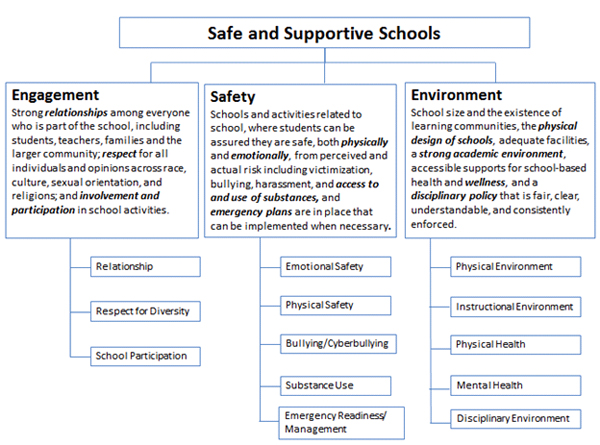
Although definitions of school environment vary, a comprehensive Safe Supportive Schools measurement model developed by the U.S. Department of Education, based on listening sessions and consultation with researchers and practitioners, reflects the most common concepts. This model includes three main components of school environment: Engagement, Safety, and Environment. The figure below1 illustrates an adapted version of this model—its components and topical areas under each—adapted from the website of the National Center on Safe Supportive Learning Environments. For more information on the importance of school environment, view a recorded webinar.
Engagement
School connectedness—students’ perceptions of safety, belonging, respect, and feeling cared for at school—appears to play a particularly important role in healthy adolescent development. It has been found to provide protection against almost every health risk behavior measured, including substance use, risky sexual behavior, violence, and emotional distress.2 Further, data on connectedness suggest that the more social domains in which adolescents experience connectedness, the less emotional distress and fewer symptoms of depression, anxiety, and stress they will experience.3
Connectedness to school has also been shown to be a significant predictor of higher academic achievement among youth.4 Analysis of data from the National Education Longitudinal Study shows that supportive, caring relationships between students and teachers, as well as teachers’ positive perceptions of students’ efforts in the classroom, resulted in higher academic achievement for students.5 Participation in extracurricular activities has been shown to be associated with positive academic, psychological, and behavioral outcomes and civic engagement.6
The importance of relationships was also reflected in student, staff, and family data collected through the Safe and Supportive Schools (S3) state grants, which identified support for improving student-student, student-adult, and adult-adult relationships as the highest need across the participating local education agency sites in both 2011 and 2012.7
Safety
Student safety includes feeling safe physically and emotionally from factors such as violence and teen dating violence, bullying and cyber bullying, and substance use. It also includes feeling safe as a result of emergency management plans in place. Students’ perceptions of feeling, or not feeling, safe at school have been shown to have an impact on their educational outcomes. School environments characterized by victimization and hostility are linked to lower levels of engagement and achievement in mathematics and reading,8 and personal experiences with threats, theft, or assault at school have been shown to increase students’ likelihood of dropping out.9 Negative outcomes are pronounced for students who are victims of bullying because these students have been shown to have lower academic achievement than their nonbullied peers. Victims of bullying, as well as bullies themselves, also report feeling unsafe at school at a higher rate than other students.10
Recent data show that students reported a higher level of fear of an attack or harm at school (4 percent) than off school property (2 percent) during the school year,11 and about 6 percent of students reported that they avoided school at least once during the previous month because they felt unsafe at or on their way to school.12
The use and sale of substances at school have also been linked to negative educational outcomes for students. A study conducted by the California Department of Education found that schools reporting a large percentage of students who stated they had been intoxicated or offered drugs on school property exhibited lower scores on academic achievement than other schools whose students did not report these experiences.13
Environment
The school environment includes a variety of factors such as the physical environment, instructional environment, student wellness, and discipline practices.
- Physical Environment: A well-maintained school environment has been shown to improve student achievement on standardized tests,14,15 and has been linked to increased teacher morale and commitment.16
- Violent incidents have been shown to repeatedly occur in the same physical spaces in schools. These locations, typically including lunchrooms, hallways, stairwells, and playgrounds, can often be characterized as “unowned,” public spaces that no one in the school feels a sense of responsibility to monitor.17 Identifying these hotspots, assigning adults in the school to monitor them, and reducing student presence in these areas, has been shown to decrease students’ perceptions of these spaces as dangerous.18
- Instructional Environment: Research has linked positive school environments to higher academic and behavioral outcomes for students,19 but in the 2007–2008 school year, 32 percent of teachers reported that student tardiness and class cutting interfered with their teaching, and 34 percent agreed or strongly agreed that student misbehavior interfered with their teaching.20 The implementation of classroom management strategies and practices can have a positive effect on decreasing problem behaviors, such as disruptions and aggression.21
- Mental Health and Well-Being: The Center for Mental Health in Schools estimates that between 12 and 22 percent of school-aged children and youth have a diagnosable mental health disorder.22 Young people with mental health problems have been shown to have lower academic achievement than their peers. Among these students, 14 percent achieve mostly Ds and Fs,23 and 44 percent drop out of school.24 School-based mental health programs can help reduce conduct disorder, attention deficit and hyperactivity disorder, and depression symptoms in students receiving services.25 Learn more about school-based mental health.
- Discipline: Punitive approaches to discipline such as zero tolerance, which embraces systematic suspension and expulsion, have been shown to lead to negative outcomes for youth. For example, data suggest that students who have been suspended are 30 percent more likely to drop out of school,26 be suspended again in the future,27 and perform poorly academically than their peers who have not been suspended.28 Conversely, proactive, schoolwide approaches to discipline have been associated with a decrease in discipline referrals and an increase in student attendance, academic performance,29 and achievement on standardized tests.30 Schoolwide approaches to discipline that focus on prevention reinforce a positive environment in which all students and staff are aware of behavioral expectations, which are enforced with predictability and monitored consistently.31
Resources
National Center on Safe Supportive Learning Environments
The National Center on Safe Supportive Learning Environments (NCSSLE) is funded by the U.S. Department of Education’s Office of Safe and Healthy Students. NCSSLE provides resources, training, and technical assistance on school climate and its components to states, grantees, district administrators, schools, teachers and staff, families, and students. The NCSSLE website highlights the most up to date and seminal research on school climate and provides links to related products, tools, and websites.
StopBullying.gov
StopBullying.gov represents a multiagency federal effort to better understand the issue of bullying and how to prevent and respond to it. In addition to the resources provided for parents and other community members, StopBullying.gov features information to help schools educate students and staff about bullying and implement policies that create an environment of safety.
Centers for Disease Control and Prevention's Adolescent and School Health: School Connectedness
This webpage from the Centers for Disease Control and Prevention (CDC) provides a definition of and information on school connectedness and why it is so important.
References
1 Adapted from Harper, 2010
2 Resnick et al., 1997
3 Libbey, Ireland, & Resnick, 2002; McGraw, Moore, Fuller, & Bates, 2008
4 Fredricks & Eccles, 2006
5 Muller, 2001
6 Fredricks & Eccles, 2006
7 Child Trends & American Institutes for Research, 2012
8 Ripski & Gregory, 2009
9 Neild, Stoner-Eby, & Furstenberg, 2002
10 Glew, Fan, Katon, Rivara, & Kernic, 2005
11 Robers, Kemp, Truman, & Snyder, 2013
12 Centers for Disease Control, 2012
13 California Department of Education, 2005
14 California Department of Education, 2005
15 Earthman, Cash, & Van Berkum, 1995
16 Cash, 1993
17 Corcoran, Walker, & White 1998
18 Astor, Meyer, & Behre, 1999
19 Brand, Felner, Shim, Seitsinger, & Dumas, 2003
20 Chapman, Laird, Ifill, & Kewal Ramani, 2011
1 Oliver, Wehby, & Reschly, 2011
22 Center for Mental Health in School, 2008
23 Blackorby, Chorost, Garza, & Guzman, 2003
24 Wagner, 2005
sup id="_ftn25">25 Hussey & Guo, 2003
26 Fabelo, Thompson, Plotkin, Carmichael, Marchbanks, & Booth, 2011
27 Tobin, Sugai, & Colvin, 1996
28 Mendez, 2003
29 Luiselli, Putnam, & Sunderland, 2002
30 Luiselli, Putnam, Handler, & Feinberg, 2005
31 Sprague, 2007