
Strategies
Dual Capacity-Building Framework for Family-School Partnerships
The U.S. Department of Education released Partners in Education: A Dual Capacity-Building Framework for Family-School Partnerships (PDF, 32 pages) for schools and their surrounding communities to serve as a model to build the kind of community engagement 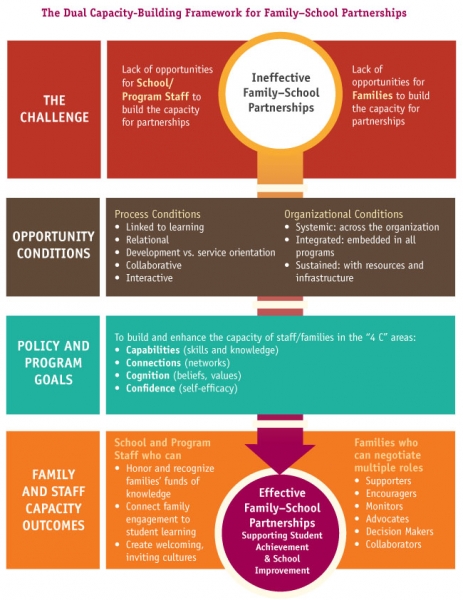 that will make schools the center of communities. The Dual Capacity Framework provides a process to enhance the capacity of staff at the district and school levels to cultivate and sustain at scale active, respectful, and effective partnerships with families that are linked to learning and support children’s learning and development and school improvement.
Father Engagement
- The U.S. Department of Health and Human Services’ Office of Family Assistance and the White House Initiative on Promoting Responsible Fatherhood and Strong Communities sponsored the National Responsible Fatherhood Clearinghouse in the development of the Responsible Fatherhood Toolkit: Resources from the Field. The toolkit provides lessons learned and resources from fatherhood programs in diverse locales throughout the nation that can be used to help develop, maintain, or expand responsible fatherhood programs.
- The U.S. Department of Health and Human Services’ Office of Head Start produced Parent, Family and Community Engagement Framework (PDF, 22 pages). This guide outlines the strategies for implementing father engagement programming across systems and services. Recognizing that father engagement is an essential component of family engagement, this framework is designed for all Head Start staff as they serve expectant fathers and fathers of infants, toddlers, and preschoolers. The framework may also be useful to other service providers — teachers, home visitors, or parent leaders — who work with fathers.
Sustainable Community Projects
Through an annual Congressional appropriation for the National Children, Youth, and Families at Risk (CYFAR) Program, the U.S. Department of Agriculture allocates funding to land-grant university extension services for community-based programs for at-risk children and their families. CYFAR is based on research on effective programs for at-risk youth and families and on the human ecological principle of working across the lifespan in the context of the family and community. To ensure that the critical needs of children and families are being met, CYFAR supports and promotes:
- Comprehensive, intensive, community-based programs that involve active participation by citizens in all phases of development;
- Building resiliency and protective factors in youth, families, and communities;
- Collaboration, forming lasting partnerships to achieve greater outcomes and provide a support base for sustaining programs for those at risk; and
- The use of technology to improve programs, provide efficient access to educational resources, and provide essential technological skills for youth and adults in at-risk environments.
Resources
Promoting Parent Engagement: Improving Student Health and Academic Achievement — Information for Parents and Families (PDF, 3 pages)
This fact sheet from the Centers from Disease Control and Prevention’s Division of Adolescent School Health provides guidance for parents and families to support parent engagement in school health.
Promoting Parent Engagement: Improving Student Health and Academic Achievement — Information for School Districts and School Administrators (PDF, 3 pages)
This fact sheet from the Centers from Disease Control and Prevention’s Division of Adolescent School Health provides guidance for school districts and administrators to support parent engagement in school health.
Promoting Parent Engagement: Improving Student Health and Academic Achievement — Information for Teachers and Other School Staff (PDF, 4 pages)
This fact sheet from the Centers from Disease Control and Prevention’s Division of Adolescent School Health provides guidance for teachers and other school staff to support parent engagement in school health.